 April 15, 2026
Evaluation-Driven Development (EDD) for AI Agents
Why shipping reliable AI agents demands a tight loop of offline experiments, online monitoring, and a continuously growing evaluation dataset — and how to actually put it into practice.
If you’ve tried to ship an AI agent that is more than a demo, you have probably noticed the uncomfortable truth: you cannot hold the whole thing in your head. A single request can branch into dozens of LLM calls, tool invocations, and self-corrections. The same prompt can work on Monday and fail on Friday, not because the code changed but because the model did — or because a new kind of user showed up. Traditional software development assumes determinism. Agents break that assumption.
Evaluation-Driven Development (EDD) is a practical response. Instead of relying on ad-hoc prompt tweaks and vibe checks, you treat evaluation the way test-driven developers treat unit tests: as the primary artifact that drives iteration. Every prompt change, model swap, or new tool is measured against a dataset that represents what your users actually do — before it ships, and again after it ships.
This post explains what EDD is, why agents specifically need it, and what a healthy EDD loop looks like in practice.
Why agents are different
A conventional backend engineer writes tests because code has edge cases. An agent engineer needs evaluations because the system itself is non-deterministic. Three things make agents uniquely hard to get right:
- Stochastic outputs. The same input can produce different outputs across runs. A passing test on one run does not prove correctness. You need statistics, not a single green check.
- Multi-step reasoning. An agent’s final answer is the product of many intermediate decisions — which tool to call, which document to retrieve, what to put in memory. A failure at step three corrupts step seven, and unit-testing the final answer tells you nothing about where things actually went wrong.
- Open-ended input space. Unlike a REST API with a fixed schema, an agent takes natural language. Users will ask things you did not plan for, in languages you did not plan for, and the distribution of inputs shifts continuously.
Together these mean that “does it work?” is not a yes/no question. It is a question about performance across a distribution of realistic inputs — and that distribution keeps moving.
The evaluation loop
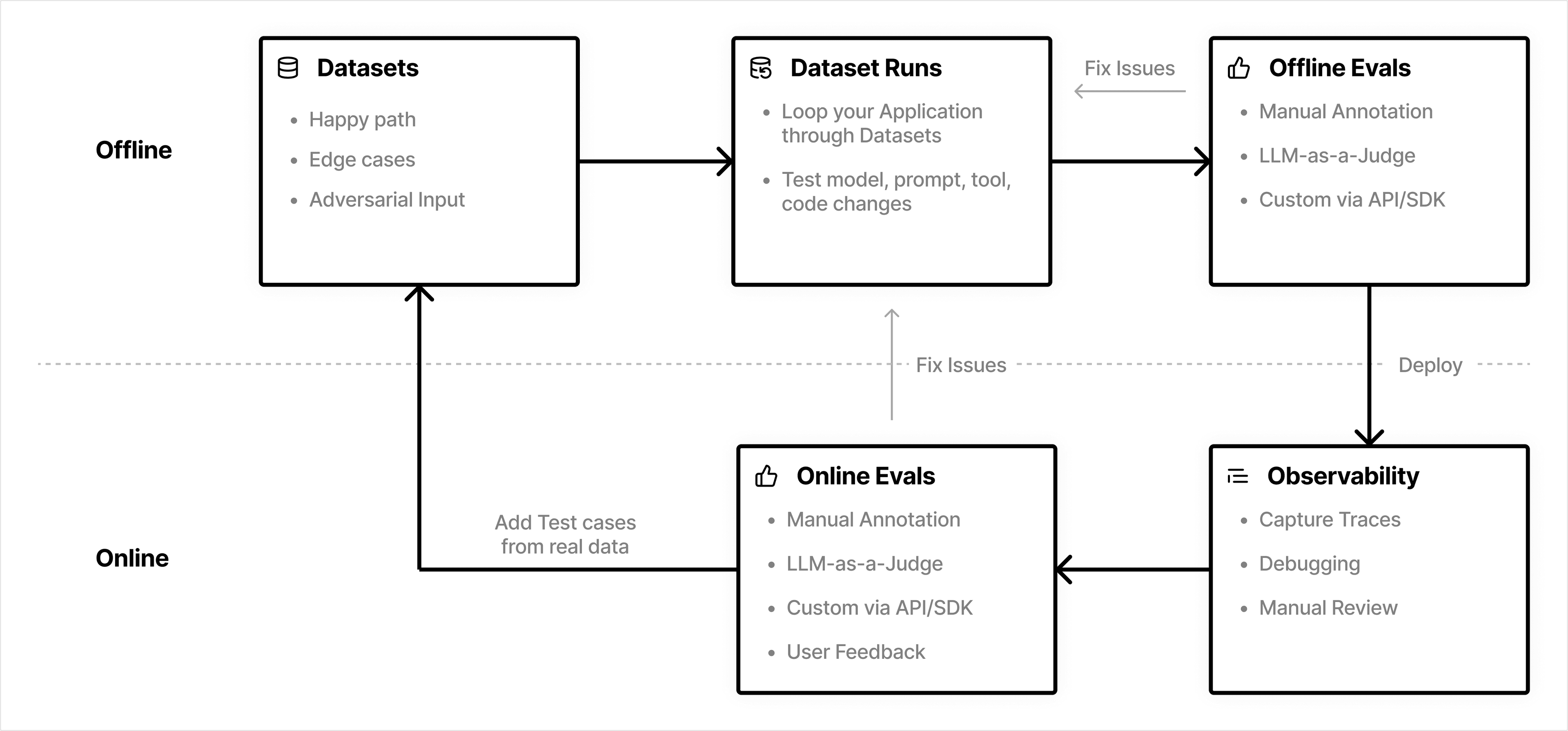
EDD rests on a simple loop that alternates between offline and online evaluation. Neither half is sufficient on its own.
Offline evaluation runs your agent against a fixed dataset of test cases before you deploy. You change a prompt, run the experiment, look at the scores, decide if the change is good enough to ship. This is where you catch regressions before your users do.
Online evaluation scores traces from real production traffic. This is where you discover the test cases you did not think to write — the French query you never tested, the malformed JSON your retriever returned, the tool that timed out once in a hundred calls. When you find one, you add it to your dataset, and the next offline run is stronger than the last.
A concrete walkthrough of how these two halves fit together is in the Core Concepts docs. The short version:
You update a prompt. You run an experiment against your dataset (offline). You review the scores, iterate, and deploy once results look good. Online evaluation then scores live traces. A user asks something unexpected — you add that case to the dataset. The next experiment catches it. Over time, your dataset grows from a handful of hand-written examples into a representative sample of real usage.
The whole point is that the dataset is never “done.” It is a living artifact that records the ways your agent has failed — and is now guaranteed not to fail the same way silently again.
What you actually need to run EDD
At minimum, four building blocks:
| Building block | What it is | Why it matters |
|---|---|---|
| Dataset | A collection of inputs, optionally with expected outputs. | The ground truth you iterate against. |
| Task | Your agent’s code, wrapped so it can be executed against each dataset item. | Keeps the thing you are testing identical to the thing you deploy. |
| Evaluation method | A function that turns an output into a score — deterministic check, LLM-as-a-judge, or human annotation. | You cannot improve what you cannot measure. |
| Experiment run | One execution of the task against the dataset, producing scored outputs. | The unit of comparison between versions. |
The Core Concepts page covers each of these in detail.
Different questions call for different evaluation methods. Deterministic checks are cheap and reliable for things you can express as code (JSON schema conformance, exact-match for extracted entities, latency bounds). LLM-as-a-judge is better for subjective qualities like helpfulness or tone. Human annotation is slow but irreplaceable for building ground truth and for the long tail of cases where automated judges disagree. A mature EDD setup uses all three, layered.
Making the loop tight
An evaluation loop that takes a day to run will not get run. Three properties separate EDD setups that teams actually use from ones that rot:
- Fast offline experiments. If a dataset run takes five minutes rather than five hours, engineers will run it on every meaningful change. Parallelize, cache, and keep datasets focused — you do not need 10,000 examples to catch the regression you are worried about.
- Automatic online scoring. Production traces should be evaluated without anyone remembering to press a button. LLM-as-a-judge pipelines that run continuously on sampled traffic surface regressions you would otherwise find via customer complaints.
- A low-friction path from production to dataset. When you find a bad trace in production, adding it to the dataset should take seconds, not a ticket. The faster this path is, the faster your dataset converges on the actual distribution of inputs.
A reasonable starting point
If you are beginning from zero, resist the temptation to build a grand evaluation framework on day one. The curve that works in practice looks more like:
- Write ten examples by hand. Real ones, ideally pulled from early user conversations. Include at least a few cases you know are hard.
- Pick one score that matters. Not five. One. Task completion, faithfulness to retrieved context, or whether the agent called the right tool — whichever corresponds to the failure mode you most dread.
- Run the experiment every time you change the prompt. Read the diffs. Notice which cases moved.
- Turn on online evaluation on a sample of traffic. Even 5% is enough to start surfacing surprises.
- Whenever a bad trace shows up in production, add it to the dataset. This is the habit. Everything else is scaffolding around it.
The dataset and the scores compound. Six months in, you will have a living specification of what “working” means for your agent, written in the examples your users actually gave you. That is the artifact EDD exists to produce — and the reason teams that take it seriously ship faster, not slower, than teams that rely on vibes.
Where Litefuse fits
Litefuse is built around this loop. Datasets, experiments, scores, and online evaluation are first-class primitives, and the trace data captured by the observability side feeds directly into the dataset side — so that every bad production trace is one click away from becoming your next regression test.
If you want to start running your own EDD loop today, the evaluation docs are the place to go next.