 April 20, 2026
What's Agent Observability and Why It Matters?
AI agents break the assumptions that traditional observability was built on. Here is what changes, what you need to capture, and why it is the foundation everything else — evaluation, reliability, cost control — depends on.
“Observability” is not a new word. Backend engineers have had traces, metrics, and logs for a decade. So when teams start shipping AI agents, a reasonable first instinct is: we already have Datadog / OpenTelemetry / Prometheus, why would we need anything else?
The short answer is that agent workloads violate most of the quiet assumptions traditional observability was designed around. You can still bolt a conventional APM onto an agent and get something — latencies, error rates, a few log lines — but you will be missing the things that actually matter for keeping an agent working. This post explains what those things are, why they are different, and why agent observability ends up being the foundation that evaluation, reliability, and cost control all rest on.
What traditional observability assumes
Classical application observability is built on a handful of assumptions that used to be reasonable:
- The program is deterministic: the same input produces the same output.
- Execution paths are narrow: a request hits roughly the same sequence of services every time.
- Failures are loud: an exception, a non-200 status code, a stack trace.
- The unit of debugging is the log line: grep the logs, find the error, fix it.
- Cost per request is predictable: you can capacity-plan from historical traffic.
An agent violates every one of these.
What breaks when you run an agent
Non-determinism. The same user input does not produce the same execution path. Two runs of an identical prompt may call different tools, retrieve different documents, and arrive at different answers. A latency histogram tells you the system is slow; it does not tell you why this particular run went off the rails.
Branching, self-directed control flow. An agent decides at runtime how many LLM calls to make, which tool to reach for, whether to reflect and retry. “How long did this request take?” is a question traditional tracing handles fine. “How many reasoning steps did the agent take before giving up, and which one produced the hallucination?” is not.
Silent failures. Agents usually do not crash. They produce an output that looks fine and is wrong. There is no stack trace for a hallucinated citation, a misremembered user preference, or a tool call with plausible-but-invented arguments. The observability system has to surface these, because nothing else will.
Opaque state. A non-trivial agent carries state across turns: conversation history, scratchpad memory, vector-store retrievals, tool outputs that get fed back in. The final output is a function of all of this, and reproducing a bug without seeing that state is essentially impossible.
Unpredictable cost. Every LLM call has a variable token cost. Every tool call may hit a paid API. An agent deciding to loop one more time is a per-request cost decision, not a capacity-planning one. If you cannot attribute cost at the trace level, you cannot control it.
What agent observability actually captures
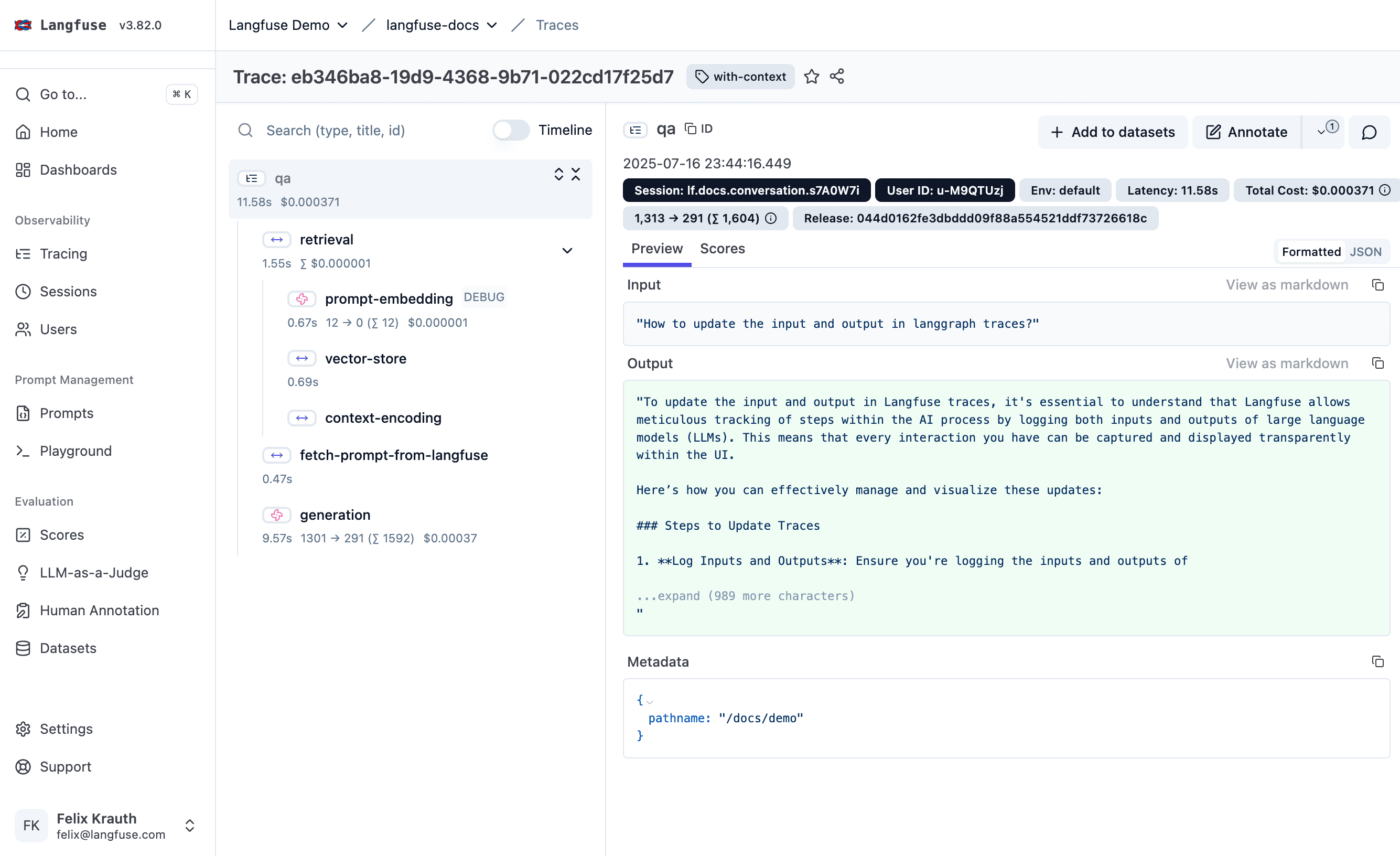
The shift from traditional observability to agent observability is a shift in primitives. You stop thinking in terms of spans + logs and start thinking in terms of structured, semantically-typed steps within a run.
The Litefuse data model organizes this into three layers:
- Observations are the individual steps inside a run — an LLM generation, a tool call, a retrieval, an agent-to-agent handoff. They are typed: a
generationis not atoolcall, because the fields you care about are different. See the observation types for the full vocabulary. - Traces group observations into one logical request. A trace is “the user asked the agent to plan a trip” — everything the agent did to answer that question lives in one place.
- Sessions group traces into a multi-turn conversation or workflow, so you can see the drift across turns, not just within a single turn.
On top of this, an agent observability system captures things a general-purpose APM doesn’t natively understand:
- Agent graphs — a visual representation of how a run actually branched between subagents, tools, and decision nodes. You stop reading waterfalls and start reading the shape of the reasoning.
- Token and cost tracking per observation, so you can see which step of which agent burned budget.
- Sessions for multi-turn context, because most real agents are conversational.
- MCP tracing — visibility into Model Context Protocol servers your agent talks to, which is rapidly becoming part of the standard agent surface area.
- Sampling, masking, environments — the operational primitives needed to actually run this in production at scale without leaking PII or drowning in volume.
And because it is all built on OpenTelemetry, you are not locked in — the same traces can be shipped to Litefuse for agent-specific analysis and to your existing APM for infrastructure correlation.
Why it matters
Agent observability is not a nice-to-have you add once the product is working. It is the substrate three other things are built on.
1. It is the only way to debug non-deterministic systems
When an agent gives a bad answer, the question is not “is there an exception in the logs.” There isn’t. The question is: what sequence of decisions produced this output? That sequence is only visible if you captured each decision as a structured observation. Without tracing, debugging reduces to staring at an input and an output and guessing what happened in between — which is exactly the mode of working that does not scale past one or two engineers.
2. It is the feedback loop for evaluation
Evaluation-driven development (covered in a companion post) depends on a steady stream of real production traces flowing back into your dataset. Offline experiments are only as good as the dataset they run against, and the dataset is only as good as the production traces it was built from. Observability is what makes that pipeline possible — every trace is a candidate test case, every bad trace is a candidate regression test. Cut the observability layer and the whole evaluation loop starves.
3. It is how you control cost and reliability at scale
Once an agent is in production, two numbers start to matter a lot: cost per user interaction, and the rate at which things silently go wrong. Both are agent-level questions, not infrastructure-level ones. Per-observation cost tracking lets you see which subagents or which tools are bleeding money. Trace-level scoring — via online evaluation — lets you catch quality regressions the moment they show up in traffic, not when a customer complains. Neither is accessible from classical metrics alone.
The takeaway
Traditional observability answers: is the system up, and how fast is it? Those are still valid questions for an agent — but they are the smallest and least interesting ones. The questions an agent team actually needs to answer every day are:
- Why did this specific run produce this specific output?
- Which steps are silently failing in production?
- Which prompts, models, or tools are getting worse over time?
- What is each user interaction costing us, and where is the cost going?
Agent observability is the category of tooling built to answer those questions. It is not optional for teams taking reliability seriously — it is the layer underneath everything else.
If you want to go deeper, the observability docs walk through the full data model and the features built on top of it.