Cookbook:使用 Litefuse 追踪 OpenAI Structured Outputs
在本 cookbook 中,你将学习如何使用 Litefuse 监控 OpenAI Structured Outputs。
什么是 structured outputs?
从非结构化输入生成结构化数据是当下 AI 的核心使用场景之一。Structured outputs 能让链式 LLM 调用、UI 组件生成以及基于模型的评估更加可靠。Structured Outputs 是 OpenAI API 的一项新能力,它在 JSON 模式与函数调用基础上做了增强,能强制模型输出严格遵守某个 schema。
如何在 Litefuse 中追踪 structured output?
如果你使用 OpenAI Python SDK,可以使用 Litefuse 提供的替换式封装,只需修改一行 import 就能获得完整日志。由此你可以在 Litefuse 中监控 OpenAI 生成的 structured output。
- import openai
+ from langfuse.openai import openai

Alternative imports:
+ from langfuse.openai import OpenAI, AsyncOpenAI, AzureOpenAI, AsyncAzureOpenAI
步骤 1:初始化 Litefuse
使用 Litefuse UI 项目设置中的 API 密钥 初始化 Langfuse 客户端,并将密钥添加到环境变量中。
%pip install langfuse openai --upgradeimport os
# Get keys for your project from the project settings page
# https://litefuse.cloud
os.environ["LANGFUSE_PUBLIC_KEY"] = ""
os.environ["LANGFUSE_SECRET_KEY"] = ""
os.environ["LANGFUSE_BASE_URL"] = "https://litefuse.cloud"
# Your openai key
os.environ["OPENAI_API_KEY"] = ""步骤 2:数学辅导示例
在本示例中,我们将构建一个数学辅导工具,输出由结构化对象组成的数组,对应解题的每一步。
这种结构非常适合需要逐步展示每一个步骤的应用,让用户可以按自己的节奏阅读解答过程。
(示例改编自 OpenAI cookbook)
注意: 虽然 OpenAI 也通过其 beta API(client.beta.chat.completions.parse)提供结构化输出解析,但该方式目前不支持设置 Litefuse 特定属性,例如 name、metadata、userId 等。请按下文示例,使用标准的 client.chat.completions.create 并通过 response_format 参数实现。
# Use the Langfuse drop-in replacement to get full logging by changing only the import.
# With that, you can monitor the structured output generated by OpenAI in Langfuse.
from langfuse.openai import OpenAI
import json

openai_model = "gpt-4o-2024-08-06"
client = OpenAI()
在 response_format 参数中你现在可以通过 json_schema 提供一份 JSON Schema。当 response_format 配合 strict: true 使用时,模型输出会严格遵循提供的 schema。
函数调用的方式大体相同,但新增参数 strict: true 后,可以确保提供的函数 schema 被严格遵循。
math_tutor_prompt = '''
    You are a helpful math tutor. You will be provided with a math problem,
    and your goal will be to output a step by step solution, along with a final answer.
    For each step, just provide the output as an equation use the explanation field to detail the reasoning.
'''

def get_math_solution(question):
    response = client.chat.completions.create(
    model = openai_model,
    messages=[
        {
            "role": "system",
            "content": math_tutor_prompt
        },
        {
            "role": "user",
            "content": question
        }
    ],
    response_format={
        "type": "json_schema",
        "json_schema": {
            "name": "math_reasoning",
            "schema": {
                "type": "object",
                "properties": {
                    "steps": {
                        "type": "array",
                        "items": {
                            "type": "object",
                            "properties": {
                                "explanation": {"type": "string"},
                                "output": {"type": "string"}
                            },
                            "required": ["explanation", "output"],
                            "additionalProperties": False
                        }
                    },
                    "final_answer": {"type": "string"}
                },
                "required": ["steps", "final_answer"],
                "additionalProperties": False
            },
            "strict": True
        }
    }
    )

    return response.choices[0].message
# Testing with an example question
question = "how can I solve 8x + 7 = -23"
result = get_math_solution(question)
print(result.content){"steps":[{"explanation":"We need to isolate the term with the variable, 8x. So, we start by subtracting 7 from both sides to remove the constant term on the left side.","output":"8x + 7 - 7 = -23 - 7"},{"explanation":"The +7 and -7 on the left side cancel each other out, leaving us with 8x. The right side simplifies to -30.","output":"8x = -30"},{"explanation":"To solve for x, divide both sides of the equation by 8, which is the coefficient of x.","output":"x = -30 / 8"},{"explanation":"Simplify the fraction -30/8 by finding the greatest common divisor, which is 2.","output":"x = -15 / 4"}],"final_answer":"x = -15/4"}# Print results step by step
result = json.loads(result.content)
steps = result['steps']
final_answer = result['final_answer']
for i in range(len(steps)):
print(f"Step {i+1}: {steps[i]['explanation']}\n")
print(steps[i]['output'])
print("\n")
print("Final answer:\n\n")
print(final_answer)Step 1: We need to isolate the term with the variable, 8x. So, we start by subtracting 7 from both sides to remove the constant term on the left side.
8x + 7 - 7 = -23 - 7
Step 2: The +7 and -7 on the left side cancel each other out, leaving us with 8x. The right side simplifies to -30.
8x = -30
Step 3: To solve for x, divide both sides of the equation by 8, which is the coefficient of x.
x = -30 / 8
Step 4: Simplify the fraction -30/8 by finding the greatest common divisor, which is 2.
x = -15 / 4
Final answer:
x = -15/4步骤 3:在 Litefuse 中查看 trace
现在你可以在 Litefuse 中查看 trace 以及 JSON schema。
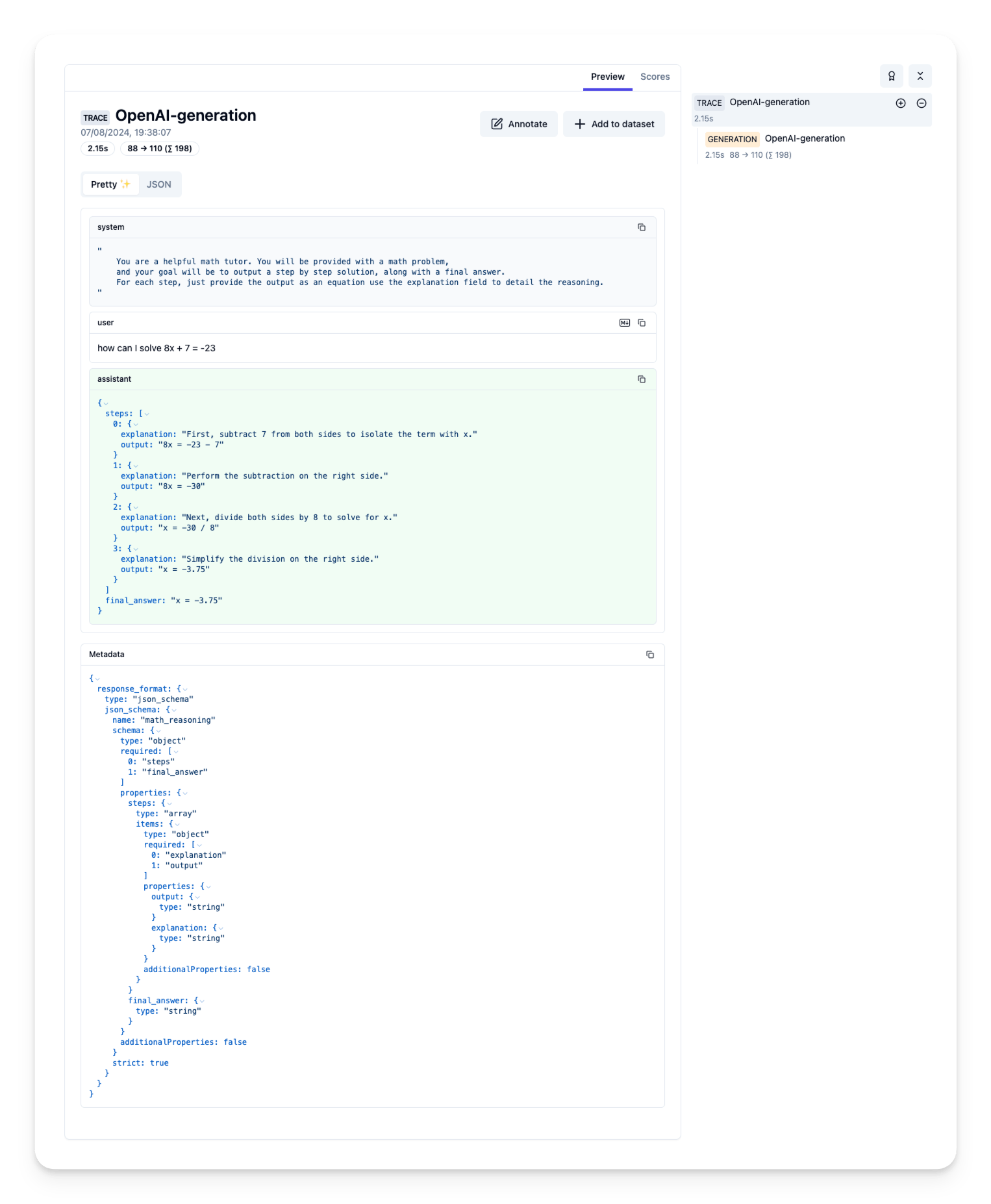
替代方案:使用 SDK 的 parse 辅助方法
新版 SDK 新增了一个 parse 辅助方法,允许你直接使用自己的 Pydantic 模型,而无需手写 JSON schema。
from pydantic import BaseModel

class MathReasoning(BaseModel):
    class Step(BaseModel):
        explanation: str
        output: str

    steps: list[Step]
    final_answer: str

def get_math_solution(question: str):
    response = client.beta.chat.completions.parse(
        model=openai_model,
        messages=[
            {"role": "system", "content": math_tutor_prompt},
            {"role": "user", "content": question},
        ],
        response_format=MathReasoning,
    )

    return response.choices[0].message
result = get_math_solution(question).parsed
print(result.steps)
print("Final answer:")
print(result.final_answer)[Step(explanation='To isolate the term with the variable on one side of the equation, start by subtracting 7 from both sides.', output='8x = -23 - 7'), Step(explanation='Combine like terms on the right side to simplify the equation.', output='8x = -30'), Step(explanation='Divide both sides by 8 to solve for x.', output='x = -30 / 8'), Step(explanation='Simplify the fraction by dividing both the numerator and the denominator by their greatest common divisor, which is 2.', output='x = -15 / 4')]
Final answer:
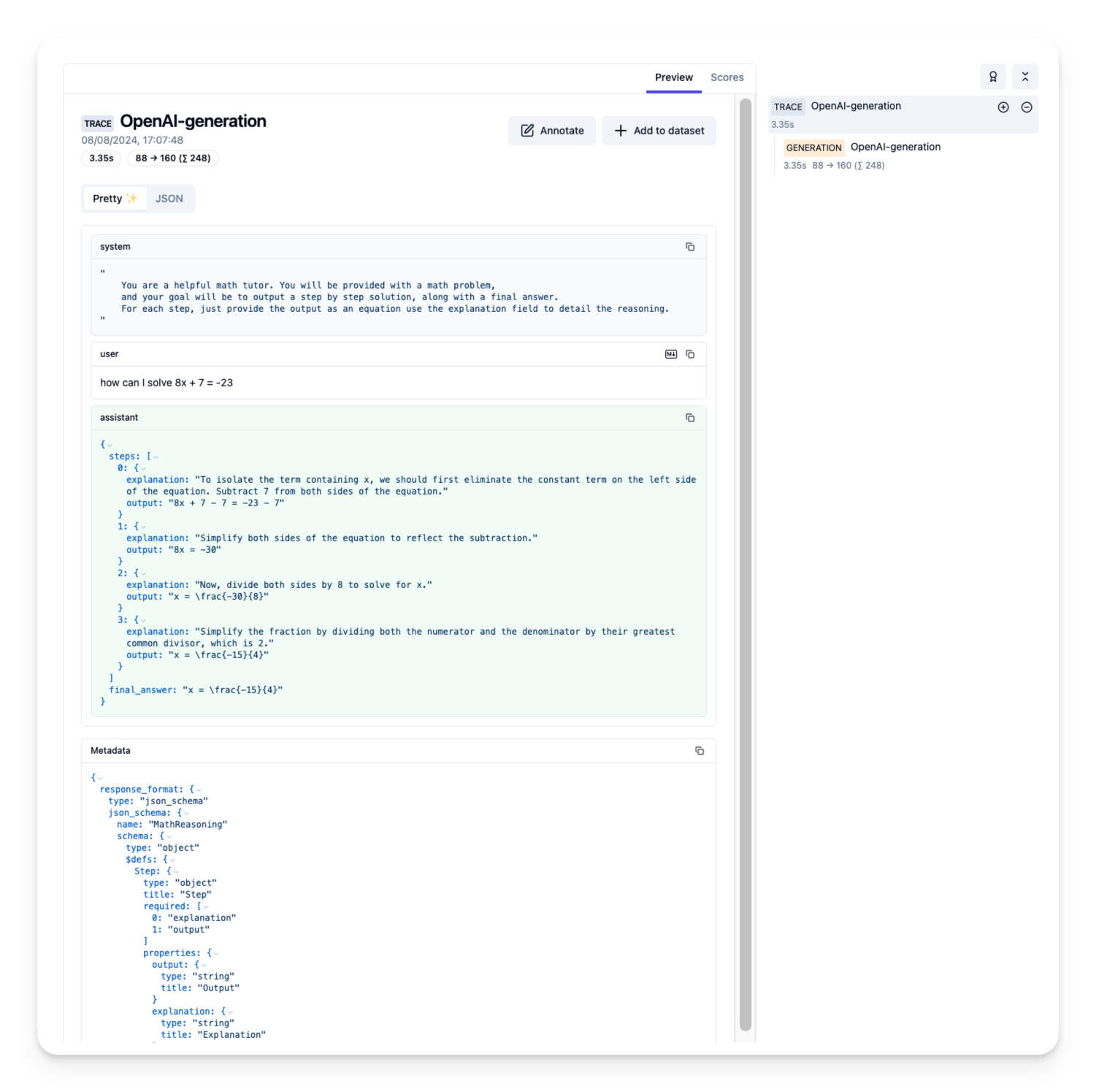
x = -15/4在 Litefuse 中查看 trace
现在你可以在 Litefuse 中查看 trace 以及你提供的 Pydantic 模型。
反馈
如果你有任何反馈或需求,请在 GitHub 上创建 Issue,或在 Discord 与社区分享你的想法。